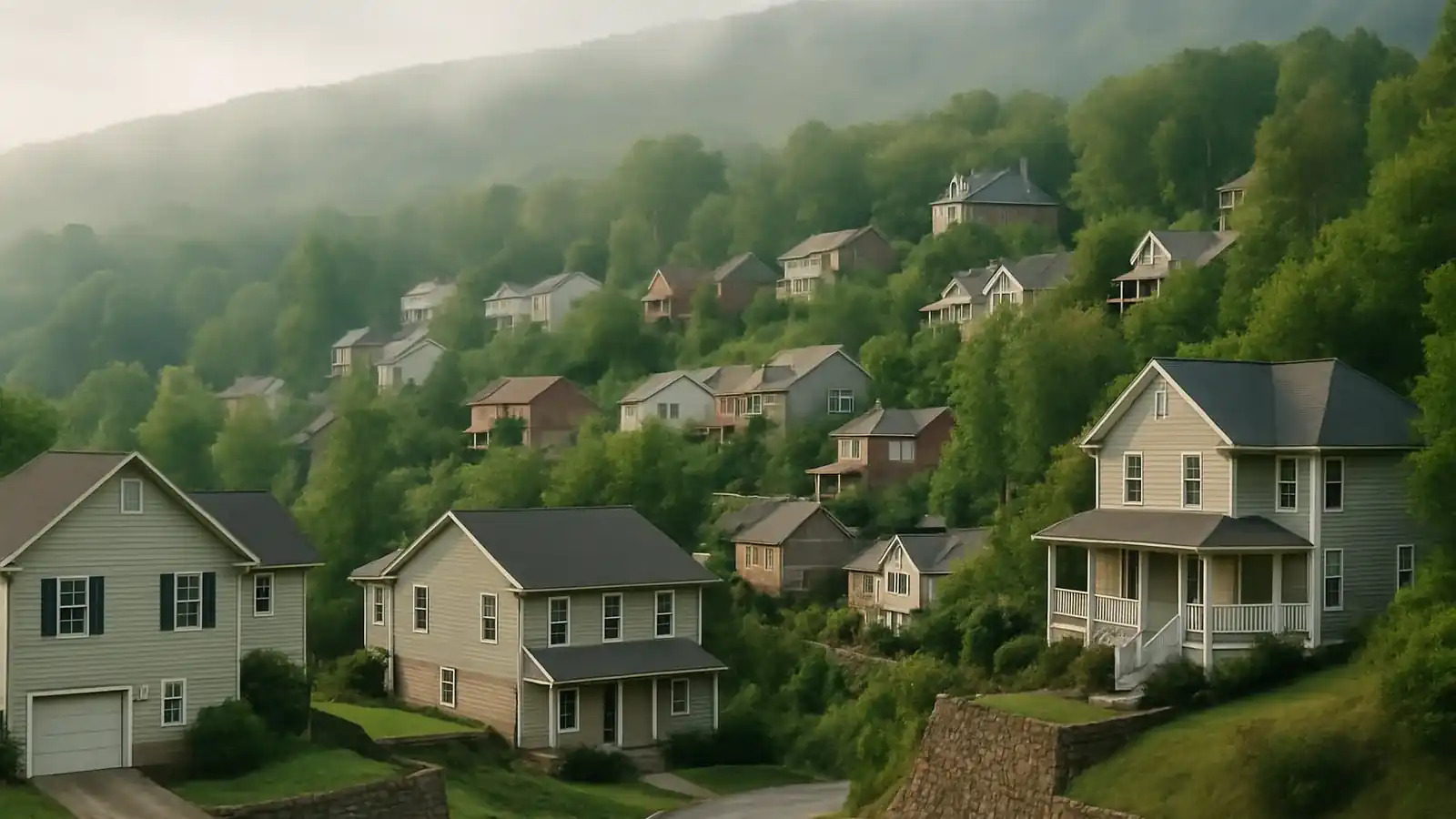
Hillside houses raise different questions than flat-lot houses, and Chattanooga has mostly the former. Below: what uphill runoff does to a foundation wall, what karst means for a pier, and which symptoms deserve a call this week.
How do I know if I have a problem?
Doors that stick in one season and swing free in another, a crack that keeps reappearing after it is filled, floors that feel out of level near one wall. These are the things people notice first, and they are worth understanding before they are worth worrying about.
How urgent is my foundation problem?
Direction and trajectory decide it. A dry vertical crack that hasn't changed can be watched. A horizontal crack in an uphill wall, any visible push-in, a retaining wall rotating at its base, or a floor that dropped in a short time deserves a measured look soon. Asking for one costs nothing, so the threshold for calling is deliberately low.
What makes Chattanooga ground difficult?
Water and terrain together. Roughly 54 inches of rain a year lands on Ridge-and-Valley slopes, so runoff concentrates rather than dispersing. A hillside foundation can receive drainage from far more ground than its own. Underneath, residual soil over limestone varies sharply in depth, which adds differential settlement.
Does drainage really fix foundation problems?
On this terrain, frequently yes, and it is the most common good outcome here. Slope runoff is what starts a large share of local foundation problems, so intercepting it above the house removes the cause rather than managing the symptom, often for a few hundred to a few thousand dollars.
Will insurance pay for it?
Usually not. Standard policies exclude earth movement and settling. Sudden events can be exceptions, like a burst supply line washing out soil beneath a footing. Ask for cause and timeline to be documented during the evaluation in the format adjusters actually use, whichever way a claim goes.
What does foundation repair cost in Chattanooga, and why do quotes differ?
What a repair costs here depends on how much of the foundation moved and how deep the piers have to go, which is why two honest quotes can differ.
What does repair cost?
Slope drainage runs under $500 to $8,000, piers $1,200 to $3,000 each, most full repairs $4,000 to $15,000, wall restraint $2,500 to $10,000, retaining wall work $1,500 to $12,000, and crack repair from about $400. The cost guide breaks down every range and what moves it.
What happens if I go ahead?
What actually happens once you say yes: timings, paperwork, and what carries over if you sell.
Should I be worried about sinkholes?
For the overwhelming majority of homes, no. The limestone valleys here do carry documented karst features, but karst-related settlement is far less common than slope water and ordinary soil movement. Anyone leading with sinkholes before ruling out drainage is selling rather than diagnosing.
Does the warranty transfer if I sell?
Ask whether it does, in writing; the paperwork matters here: buyers' inspectors in this market look hard at the uphill side, the crawl space, and any retaining wall. Keep the pier log, stage photos, and drainage documentation with the warranty; the package is what satisfies an inspector.
How long does the work take?
Crack injections take hours. Drainage correction runs one to two days. Wall restraint one to three days. Retaining wall work from a day to a week depending on whether it's drainage, anchors, or a rebuild. Piering two days to a week. Your written scope states the timeline before work begins.
Still deciding?
The cost guide explains every range in detail, and our services covers each repair type. When you're ready, the evaluation puts numbers on your specific house.
Get a Chattanooga foundation evaluation
Tell us what the house is doing (stair-step cracks, a wall pushed in on the uphill side, water crossing the lot, sloping floors) and we'll pass it to one independent local specialist for an evaluation. You get a call back from a local specialist who serves Chattanooga.